QR code art generator alternatives.
Three different kinds of tool get called "QR art generator", and picking the wrong kind wastes an afternoon. Some invent a picture from a text prompt. Some take the picture you already have and make it carry the data. A few go further and let that printed code become an augmented-reality target. What you need depends on one question: does the picture have to be yours?
The three kinds
| AI prompt generators | Image-encoded codes | Interart art codes | |
|---|---|---|---|
| Where the picture comes from | Invented from your text prompt | The file you upload | The file you upload |
| Same result twice? | No — each run differs | Yes | Yes |
| Scannability | A slider you balance yourself | Varies by tool; the good ones decode-check | Two decoders, nine camera conditions, refuses to publish a failure |
| Can the code be an AR marker? | No | No | Yes — the printed code can be the tracked target |
| Examples | QRBTF, QR-Verse, QuickQR Art | sqr.art, open-source halftone generators | This one |
If the picture has to be your own
Prompt-based tools — QRBTF is the best-known open-source one — generate imagery with a diffusion model and bend a code into it. They are genuinely good at what they do, and completely useless if you have a painting, a logo or a photograph that has to be the thing people see. Your artwork is not an input. Ask for "a koi pond in ink wash" and you get someone's idea of one; ask twice and you get two different ponds.
Image-encoded generators do the opposite: the picture you upload is what carries the data. That is the family Interart's art code generator belongs to, alongside sqr.art and a handful of open-source halftone projects. If you came here with a file, this is your category.
If the code has to survive being printed
A code that looks beautiful on screen and fails on a card is worse than an ugly code. The honest question to ask any tool is what did you check before you gave me this file? Prompt tools generally hand you the trade directly: QRBTF's own guidance is that higher control strength scans better and looks more like a plain code, while lower strength looks better and may not scan — your judgement, your print run.
Interart checks every code with two independent decoders across nine simulated camera conditions — small in the frame, motion-blurred, held at an angle — and will not publish one that fails. The artwork gives up detail only as far as it must to pass, in that order: pattern, dot size, dot boldness, then finally colour, which almost never gets touched. Nothing here is judgement you have to exercise.
If the code should do more than open a link
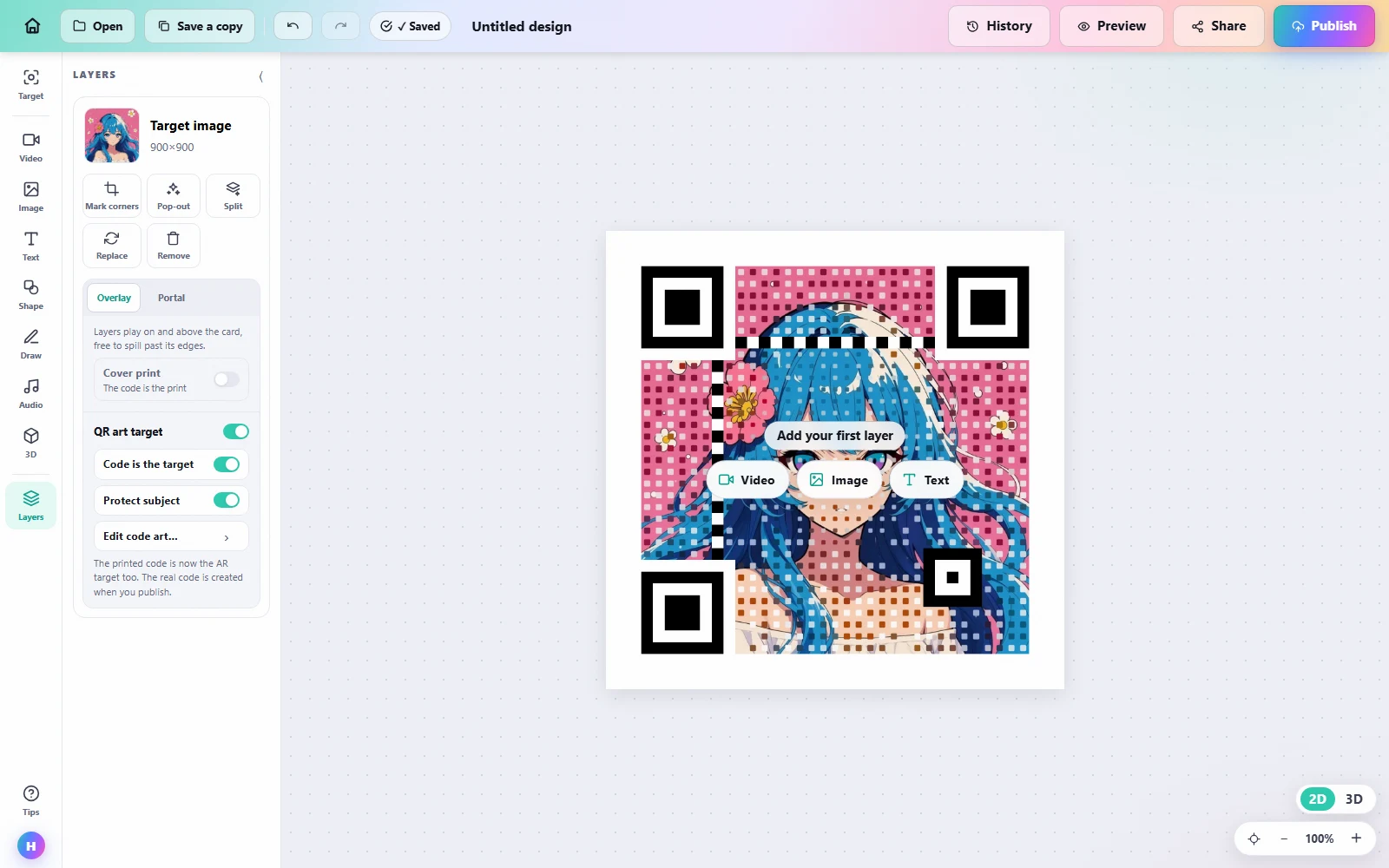
Every tool on this page produces a code that opens a URL. Interart's can also be the AR marker itself: because the code is made of artwork it keeps the irregular detail that image tracking follows, so the printed sheet both opens the link and anchors what plays on top of it. One card, scanned once, then held up while video or 3D plays locked to it. If you only need a link, this is irrelevant — say so to yourself before paying for it.
When another tool is the better choice
Be honest about the gaps. Choose a prompt generator when you have no artwork and want imagery invented for you. Choose sqr.art if you need print-ready SVG, WiFi or bank-transfer codes, or a destination you can re-point after the code is printed — it had all of those and per-code pricing when we checked in August 2026. Choose an open-source halftone generator if you want the pixels and nothing else: no account, no service, no link that can ever be turned off. Choose a plain black-and-white code when the code is going somewhere nobody looks — the back of an invoice, a warehouse shelf — because plain codes scan best of all, and dressing one up buys you nothing there.
Questions, answered
What is the difference between an AI QR code generator and a QR code art generator? An AI QR code generator invents a picture from a text prompt and bends a code into it — your own artwork is never involved, and two runs of the same prompt give different pictures. An image-encoded generator takes a picture you already have and makes that picture carry the data. If you have artwork, a logo or a photograph that has to appear, you want the second kind.
Are AI-generated QR codes reliable enough to print? Treat them as unverified until you test them. Prompt-based tools expose the trade directly — QRBTF, for instance, tells you that higher control strength scans better but looks more like a plain code, and lower strength looks better but may be harder to scan (checked August 2026). Whatever tool you use, scan the finished file with more than one phone before ordering a print run.
Is there a free QR code art generator? Interart's is free to preview without an account, and a free account produces five real codes a month with commercial use included. Open-source halftone generators are free but are browser or command-line demos with no accounts, link management or verification. Several paid tools offer a free preview and charge per code — sqr.art, the closest commercial equivalent, was €5 per code with plans from €9 a month when checked in August 2026.
Which QR art tool works with augmented reality? Interart is the one we know of where the printed code can also be the AR tracking target: because the code is made of your artwork it keeps enough visual detail to be tracked, so one printed sheet both opens the link and anchors the AR. Other art-code tools produce a code that opens a link, which is all most people need.
Competitor details were checked in August 2026 on qrbtf.com and sqr.art. Products change; if something here has gone out of date, trust their pages over ours.
Keep reading
QR code art generator · Can a QR code be the AR marker? · QR codes vs image tracking · Pricing